Best seller
How to size, pack, fit and wear a school bag so that carrying it does not become a problem. Five minutes here saves a lot of complaints about shoulders later.
A school bag is worn roughly 190 mornings a year by a body that is still growing. Almost every complaint about school bags — sore shoulders, a stiff neck, a child who walks leaning forward — comes down to one of four things: the bag is too big, it is too heavy, it is packed wrongly, or it is worn wrongly. All four are fixable, and three of them are free.
The widely used guidance is that a loaded school bag should not exceed 10% of the child's body weight, and should not routinely exceed 15% under any circumstances. It is a rule of thumb rather than a clinical threshold, but it is a useful one because it scales with the child instead of with the bag.
| Child's weight | Target maximum (10%) | Absolute ceiling (15%) |
|---|---|---|
| 20 kg (approx. age 6) | 2.0 kg | 3.0 kg |
| 28 kg (approx. age 8) | 2.8 kg | 4.2 kg |
| 35 kg (approx. age 11) | 3.5 kg | 5.3 kg |
| 45 kg (approx. age 13) | 4.5 kg | 6.8 kg |
| 60 kg (approx. age 16) | 6.0 kg | 9.0 kg |
Weigh the bag on bathroom scales one Monday morning. Most people are surprised. If it is over, the fix is usually a water bottle filled at school instead of at home, one textbook left in a locker, and a bag that is physically smaller so it cannot hold as much. This is why we publish the empty weight of all twenty-three models — a bag that starts 300 grams heavier has used up 10% of an eight-year-old's allowance before anything goes in it.
A larger bag does not stay half empty. It fills up, because there is room. Buy the capacity the child needs now and replace it when the requirement genuinely changes — usually twice in a school career, at the move to junior school and again at the move to secondary.
Backpack fit is set by back length, not height and not age. Measure it in two minutes with a soft tape:
Ask the child to tip their head forward. The bony lump that stands out most at the base of the neck is C7. That is the top of the measurement.
Place your hands on the child's hips, thumbs pointing backwards, and find the top of the pelvis. The line between your thumbs is the bottom of the measurement.
Down the line of the spine, C7 to the iliac crest line. That figure is the back length.
The bag's back panel should be no longer than the measurement. A backpack whose base sits more than about 5 cm below the top of the pelvis is too long, whatever the label says.
| Back length | Suggested capacity | Models to look at |
|---|---|---|
| 28–32 cm | 8–10 litres | Kinderpak, LitePak XS |
| 32–36 cm | 12–14 litres | Minor, LitePak Small |
| 36–41 cm | 16–20 litres | Junior, LitePak Medium |
| 41–45 cm | 22–26 litres | SchoolPak, OmniPak, LitePak Large |
| 45 cm and over | 32–41 litres | Maxi, DuoPak |
Where the weight sits inside the bag changes how heavy it feels more than the weight itself does. A load held away from the back acts on a longer lever and pulls the shoulders backwards, which the child compensates for by leaning forward. The further from the spine, the worse the effect.
This is why our backpacks carry a semi-rigid sheet behind the main compartment: it holds books flat and stops a ring binder corner pressing through the padding into the child's back.
Lifting a heavy bag from the floor with a straight back and a twist is how most bag-related strains actually happen. Teach the child to put the bag on a chair or a low wall, face away from it, put one arm through, then the other, and stand up with bent knees. Coming off, reverse it — never swing a loaded bag off one shoulder.
A backpack is the best choice for most children because it distributes load across both shoulders and the pelvis. But not always:
The information here is drawn from widely published ergonomic guidance on children's rucksacks. It is not a substitute for professional medical advice. If your child has persistent back, neck or shoulder pain, speak to your GP or a registered physiotherapist.
Padded, ventilated panels, contoured straps and — on the largest three — a hip belt.
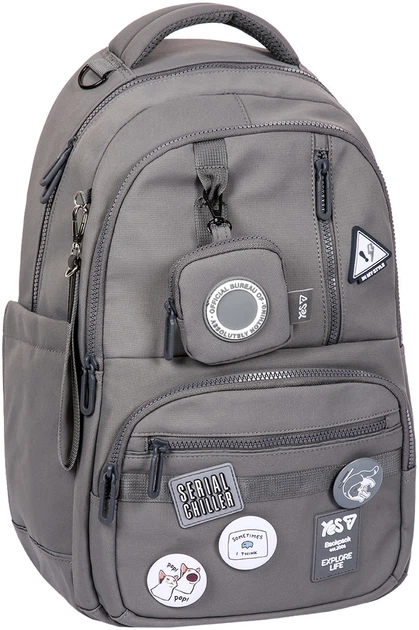
Sixth form capacity — laptop, folders and kit, with the LitePak back system scaled up.